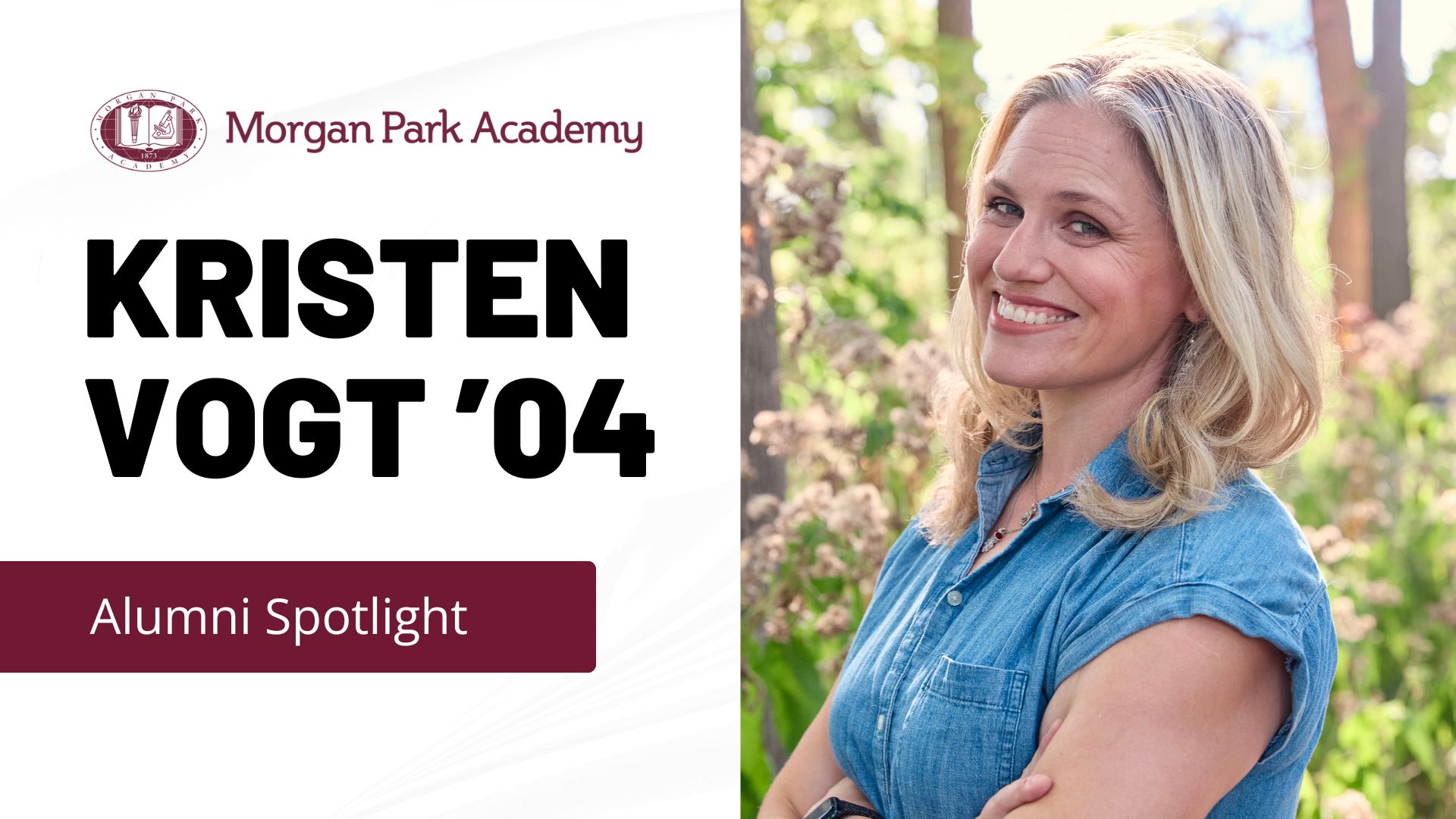
Kristen Vogt Veggeberg, M.P.A., Ph.D., is the Director of STEAM and Workforce Development at Scouting America in Chicago, where she applies her doctoral research in informal STEM education from the University of Illinois. She is currently serving her second term on the Field Museum’s Associates Board and consults with the National Science Foundation’s Education Department.
An accomplished writer as well as an educator, Dr. Vogt Veggeberg recently published new fiction in Paragraph Planet and has contributed to Neon Origami, NUNUM, Massive Science, and more. She credits her early work on the MPA lit mag and student newspaper for helping her balance a dual passion for writing and professional impact. Explore her latest writing on Substack at A Cautiously Optimistic Future.
Q&A
What’s one challenge you faced at MPA, and how did it shape who you are today?
I suffer from dyscalculia and NVLD, meaning that numbers bounce around when I look at them. My brain does not process theory well when I don’t have physical data in front of me. As a result, I have always struggled with quantitative work, especially seemingly esoteric math that did not seem to have applications within the real world. It was rough comparing myself to other students for whom studying numbers and repeating them came easily.
Luckily, my Algebra 2 teacher, Geoffrey Lewis, had a different approach. If numbers and equations needed to be exchanged and supplanted in the problems, then so could the problems themselves.
He tapped into my creativity, especially after he read my writing and saw my artwork in both the student newspaper and lit mag. He asked me to compose complex stories in which equations, especially statistics, played a role. Using tales of increasing size proportions with Gulliver’s Travels, or calculating the probability that Mr. Lewis was going to be eaten alive by giant mosquitos while on vacation in Hawai’i. (We got a little silly!)
I didn’t realize it at the time, but I was being prepped for not only applications of real-world statistics as a high schooler, but also as a taste of science communication as well. It wasn’t just about the numbers, but the story around them.
I earned my first ‘A’ in math thanks to Mr. Lewis. Years later, while composing a report for the New York Hall of Science as part of my graduate research at the Learning Sciences Research Institute at the University of Illinois, I thought about that experience in his math classroom. How I had to apply the story of the numbers of visitors that we had, how they engaged, and what their movements and gestures said about the subsequent data presented. Rather than just theoretical numbers.
I ended up presenting that research at the American Association for the Advancement of Science the next year.
In fact, the first article I wrote for Science Unsealed, specifically reflected on my experience with learning about applied math at MPA.
Starting while a freshman at University of Oregon, I found myself drawn to the field of out-of-school learning, with a specific focus on STEAM — science, technology, engineering, arts, and, of course, math.
A learner’s performance was not a part of the learning experience in museums, or any other learning environment in a nontraditional setting. Learning was not about numbers, it was about the experience, especially in regards to creating a product that could be useful or engaging to others.
The concept of experience vs. performance was not only the backbone of my dissertation on inequities in STEM education while at the University of Illinois, but has become a core part of my subsequent career with both Scouting America and the National Science Foundation, too.
Who else at MPA made a lasting impact on you? What did they do or say that has stayed with you?
In addition to Mr. Lewis, I would be remiss if I did not mention the Holy Trinity of tough writing teachers at MPA: Claire Concannon, Barry Kritzberg, and Elizabeth Yellen, Ph.D.
I left all of their classrooms able to write clear, concise essays and stories. Even more than numbers, a clearly-written, engaging story is necessary for all pieces of writing, whether it is a foundation’s report, a book chapter, or a piece of flash fiction. It is what breaks or makes a multi-million dollar grant proposal, a partnership with an external organization, or even getting someone to read what you posted on your science fiction blog.
Ms. Concannon’s dedication for exacting words may have intimidated some, but I credit her with teaching me how to not only finish massive projects, but be able to hone them down in a way that is applicable to an editor’s approval. This is true whether the subsequent piece finds location in a peer-reviewed journal, a textbook, or a short story symposium. Responses that cowed others were water off my back.
Ms. Concannon once told us that studying — and writing — should never be ‘crammed’ the night before. That you can only master a subject, or complete a project, by dedicating time every day to work on it.
In addition to writing, learning how to critically dissect any piece of media was vital. In this current age of misinformation, it is crucial to have the ability to see bad information portrayed as truth. Mr. Kritzberg emphasized this in both Journalism and AP Literature, and Dr. Yellen did so in Film Studies, especially with media that was either independent or foreign.
Mr. Kritzberg’s maxim in Journalism Lab — “Write for the Kansas City milkman” — might have seemed maudlin to some, but it is the truth. When you can compose something relatable, engaging, and easy to read, it increases the probability of not only your message’s impact, but your audience’s reach as well.
I have used that phrase in multiple lectures on effective writing, ranging from a graduate school level lecture at UC San Diego to a workshop I designed for the American Association of Anthropology.
Additionally, Mr. Kritzberg often cited Kurt Vonnegut as a writing inspiration, as did Sherry Grutzius, my teacher for English 3 Honors junior year.
Lo and behold, I attended a meeting on crafting public policy at the Harris School at University of Chicago earlier this month, led by legendary policy writer and New York Times author David Chrisinger. In front of a very international crowd, mostly Ph.Ds, Chrisinger heavily quoted Kurt Vonnegut, both on his works Man in the Hole and Slaughterhouse Five, and asked if we were familiar with him.
I almost laughed out loud. If only he knew that I had read those Vonnegut pieces when I was at Morgan Park Academy!
How did your time at MPA prepare you for college, your career, or the path you’ve taken since graduation?
You can have the best grades, but you must be able to handle other things that life will throw at you with both courage and grace. Creativity helps, too.
Having been humbled by peers and educators alike in high school, I came into the university classroom with a sense of humility that not many had. I did not expect to be the top student, but I was determined that I was going to love learning and be an active participant in my university classroom, regardless of the outcome.
I was genuinely surprised that I made the Dean’s List — again, and again. Later on, when I transferred to UC Berkeley, I was even more surprised that I maintained a 4.0 GPA while working for Burning Man in downtown San Francisco in the evenings. Studying and managing a loaded schedule was like breathing for me.
Additionally, when a door is shut in your face, don’t attempt to kick it down. See if you can unscrew the hinges and give it a gentle push instead.
In my case, when I was accepted into graduate school for my Master’s right out of undergrad, I knew my GPA and GRE scores were extremely competitive, even compared to individuals who had years of professional experience under their belts that I did not.
So I reached out to the department, and asked if it was possible to apply this background to help offset costs. I was fortunate to receive a fellowship from the university, and finished my Master’s in Public Administration with no student loans. I repeated the same a few years later for my Ph.D at the University of Illinois.
I left MPA with those skills at 18. It is safe to assume that these abilities are to credit for my work and career. I genuinely would not be where I am today had I not been in the boiler room that was MPA.
What values or life lessons from MPA still guide your decisions and actions today?
In my career, I’ve hung out with Nobel Peace Prize nominees, eaten dinner with astronauts, shaken hands with senators, and once crashed a lecture given by Woody Harrelson while I was a freshman at Oregon. (He doesn’t like me, for what it’s worth.)
Every single time, I went in with a sense of not only curiosity, but a sense of modesty. I learned that from having peers that were not only intellectually diverse, but culturally and sociologically, too. I learned not only who avoided what foods or what habits, but why they did, and why that was so important to them. It’s one of the reasons I was drawn to anthropology as a major, and why I worked with both the American Association of Anthropology and the Society for Applied Anthropology as a graduate student.
That respect and curiosity has been key to making partnerships as both an academic and as a professional. Ask individuals about themselves, and listen intently. You have no idea what others will have in common with you — be it a food, a sports team, or even the same coffee shop in the West Loop.
Listening is not a born skill, and whoever tells you otherwise is full of it. It is one that needs to be practiced daily — once again, I reference Ms. Concannon’s voice on the matter.
I travel a lot for my current position, and often draw on the cultural lessons I learned at MPA. Whether it’s sharing a cup of strong coffee with a Palestinian shop owner on Harlem Ave, negotiating research contracts with Northwestern University, or leading a workshop on science education in Coos County, Oregon, I’ve been able to learn so much because I was able to listen and understand my fellow man.
If you can keep a sense of self-assurance with a grasp of humility, every place is open to you.
Why is it meaningful for you to stay connected to MPA and the alumni community?
It is always interesting to see what other alumni are up to. For example, Jennifer Zale ’02, one of my closest friends from MPA, spent time in Ukraine as a dancer for their state ballet, and after earning her Ph.D, has been working with both refugees and victims of gender violence in multiple countries. I’ve used music sung by my friend Elizabeth Reiter ’04 in her opera career in Germany as an example for some of my colleagues who never got into Wagner’s Ring Saga. And then other classmates have quieter lives, but almost all are fascinating in their own way.
Additionally, a more tragic reason to stay in contact is because it gives us reason to know when something happens to one of us. It is not a mystery within a tight knit community. Many of my fellow alumni were truly heartbroken to hear of the passing of our former teacher Michael Weil in October 2025. It was good for us to gather remotely and grieve his loss from this world.
What advice would you share with current students about making the most of their time at MPA?
Your peers will challenge you in ways that you never knew possible. Socially, emotionally, and especially intellectually. Soak it up. It will make you a more rounded human for this world.